Best Inverters for Caravan & RV India — Genus 2.4KVA (Built-in Lithium) + Green Cell 1500W (2026)
Your caravan has a ₹2 lakh battery bank. 200Ah lithium cells. 1600W solar panels on the roof. Everything charged and ready. You flip the switch to turn on the AC, start the microwave, or run the washing machine and... nothing happens. Or worse — your appliances make a horrible buzzing noise and refuse to start.
Here's the brutal truth most first-time caravan builders don't understand: your ₹2 lakh battery bank is USELESS without a proper inverter. It's like having a Ferrari engine with no transmission — all that power stored with absolutely no way to USE it for your kitchen, AC, or washing machine. Your battery stores energy as 12V/24V/48V DC. Your appliances need 230V AC. The inverter is the "translator" that converts stored DC power into usable AC power. Without it, your expensive battery bank can only run USB chargers and LED lights. That's it.
And here's what makes it worse in India: cheap inverters destroy expensive appliances. A ₹3,000 modified sine wave inverter from a local shop might technically output 230V — but the waveform is so choppy that sensitive electronics overheat, motors buzz and vibrate excessively, and compressors in fridges and ACs cycle erratically. You save ₹10,000 on the inverter and lose ₹50,000 worth of appliances within a year.
Disclosure: This article contains affiliate links. If you purchase through our links, we may earn a small commission at no extra cost to you.
Advertisement
Pure Sine Wave vs Modified Sine Wave — When Does It Actually Matter?
Every inverter discussion starts with this question. Here's the definitive, no-BS answer for caravan owners:
- Pure Sine Wave: Produces a smooth, continuous wave identical to what comes from your home wall socket (MSEB/BSES/TATA Power grid). Every appliance on earth is designed to run on this waveform. Motors run silently, compressors start smoothly, sensitive electronics (laptops, medical equipment, audio gear) work perfectly. Zero compatibility issues. Zero buzzing. Zero overheating. This is what expensive inverters produce.
- Modified Sine Wave: Produces a "stepped" approximation — a blocky wave that roughly mimics a sine wave. It's cheaper to manufacture, so the inverter costs less. About 90% of appliances work FINE on modified sine wave: lights, fans, phone chargers, power tools, heaters, basic kitchen appliances, microwaves. The 10% that DON'T work well: variable-speed motors (some washing machines), medical equipment (CPAP machines, oxygen concentrators), high-end audio equipment, and some laptop chargers that produce coil whine.
🎯 The Practical Rule for Caravans:
• Pure Sine Wave: If you're running AC units, inverter refrigerators, washing machines, or CPAP machines — you NEED pure sine wave. No exceptions.
• Modified Sine Wave: If you're running basic loads (lights, fans, phone/laptop charging, power tools, microwave, kettle) — modified sine wave saves you ₹5,000-15,000 and works perfectly fine.
• Our recommendation: If budget allows, ALWAYS go pure sine wave. It's future-proof. You might not run an AC today, but next summer you will. Buy once, buy right.
Essential Caravan Equipment — Must Have
Critical components for any caravan build or upgrade:
Why VA/KVA Ratings Matter — The Startup Surge Trap
This is where 80% of caravan owners make a catastrophic mistake. They buy a 1000W inverter to run a 1000W microwave. Sounds logical, right? Wrong. Dead wrong.
- Continuous watts vs startup surge: Every motor-based appliance (AC, fridge, washing machine, water pump, mixer grinder) draws 2-5x its rated wattage during the first 0.5-2 seconds of startup. A 1000W microwave needs ~1500W to start. A 1HP AC needs 3000-4000W for the compressor's initial surge. A 750W mixer grinder surges to 2000W+ when you first press the button.
- VA ≠ Watts: VA (Volt-Amperes) accounts for reactive power in AC circuits. Roughly: Watts = VA × Power Factor (typically 0.7-0.8). So a 2400VA inverter delivers approximately 1800-1920W of actual usable power. Don't confuse the VA rating with wattage — always check the WATT output.
- KVA = Kilo Volt-Amperes: Simply VA divided by 1000. A 2.4 KVA inverter = 2400 VA. Marketing often uses KVA because the number looks bigger. Focus on the actual watt output instead.
- The sizing rule: Your inverter's continuous watt capacity should be at LEAST 1.5x your heaviest single appliance. For peak/surge capacity, you need 2-3x your heaviest appliance's rated wattage. This ensures the inverter handles startup surges without tripping or shutting down.
⚡ Real-World Sizing Example for a Caravan:
• 1HP AC compressor: 750W running, 2500W startup surge
• Microwave: 1000W running, 1500W startup
• Water pump: 84W running, 200W startup
• Lights + fans + charging: 200W constant
• You need: Minimum 2400VA (pure sine wave) to handle the AC startup + other loads simultaneously
• A 1000W inverter would trip the moment the AC compressor kicks in. Money wasted.
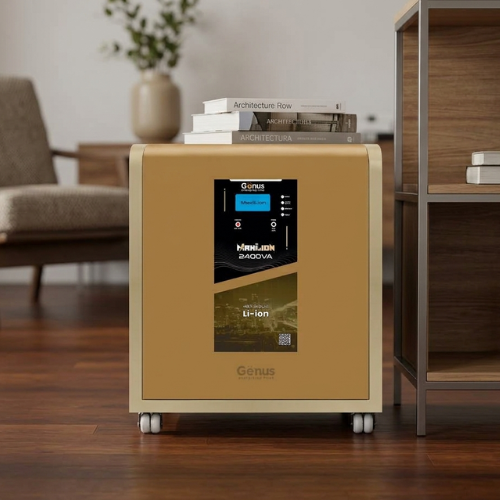
#1 — Genus MaxiLion 2400 VA (2.4 KVA) with Integrated 2560Wh Lithium Battery
This isn't just an inverter — it's your complete caravan power solution in a single box. Inverter + battery integrated into one unit. No separate battery purchase. No wiring between inverter and battery. No compatibility headaches. No acid fumes. No water topping. Just plug in your caravan appliances and you have power. This is the product that makes caravan electrical systems simple for the first time.
Why this is the ultimate caravan power solution:
- ALL-IN-ONE: Inverter + battery in a SINGLE unit: No separate battery purchase, no wiring between inverter and battery, no compatibility issues. Most caravan builders spend weeks researching which battery works with which inverter, what gauge wiring to use, what BMS settings to configure. The Genus eliminates ALL of that. Plug in your caravan appliances and GO.
- 2560Wh (2.56kWh) integrated lithium battery: That's enough to run your fridge (60W × 24h = 1440Wh) + LED lights (50W × 8h = 400Wh) + fans (75W × 10h = 750Wh) for a full 24+ hours without any charging source. For a typical caravan evening (lights + fan + TV + phone charging), you get 2-3 nights of power from a single charge.
- Runs 1HP motor: This is the spec that matters most for caravans. 1HP = AC compressor startup. It means this inverter handles air conditioning, washing machines, heavy mixer grinders, and water pumps without breaking a sweat. Cheap inverters choke and trip on motor loads. The Genus is specifically designed for them.
- 12-year battery life: Lithium-ion with proper BMS (Battery Management System) delivers 3000-5000 charge cycles. At one cycle per day, that's 8-14 years of daily use. You'll renovate your entire caravan twice before this battery needs replacement. Compare that to lead-acid batteries that die in 2-3 years.
- Lithium-ion: lightweight, zero maintenance: No water topping every month. No acid fumes in your living space (critical in a closed caravan). No risk of acid spills on your caravan floor. No terminal corrosion. No equalisation charges. Install it and literally forget about it for a decade.
- Perfect for caravans without existing battery banks: If you're building a new caravan or converting a vehicle, this eliminates the most complex part of the electrical system. No need to research battery types, calculate Ah requirements, buy a separate BMS, figure out charging profiles. It's all integrated and pre-configured.
- Genus is an Indian brand with nationwide service: 6000+ service centres across India. If something goes wrong in Rajasthan, Kerala, or the Northeast — there's a Genus service centre nearby. Try getting warranty service for a Chinese inverter brand in rural India. Good luck.
💡 Space Savings in a Caravan:
A separate inverter + lithium battery setup occupies 2-3 cubic feet of precious caravan space, plus requires heavy-gauge cabling between them. The Genus MaxiLion is ONE box. You save at least 40% of the space, eliminate all inter-component wiring, and reduce weight by removing redundant casings and connectors. In a caravan where every inch matters, this is transformative.
Genus MaxiLion 2400 VA (2.4 KVA) Inverter with Integrated 2560Wh Lithium-Ion Battery
2.4 KVA | 2560Wh Built-in Lithium Battery | Runs 1HP Motor | Up to 12 Year Life | Home, Office, Shops
Check Price on Amazon ↓
Check Price & Buy on Amazon →Advertisement
Essential Caravan Equipment — Complete Your Setup
Whether buying or renting, these 3 components make the biggest difference in your caravan experience:
#2 — Green Cell 1500W / 3000W 12V to 230V Inverter (Best Portable Option)
Already have a 12V battery bank in your caravan? Maybe you built a LITOR lithium setup, or have AGM batteries from your solar system. What you need now is a reliable, portable inverter that converts your 12V DC into standard 230V AC. The Green Cell does exactly that — and it does it with European engineering quality at a fraction of the price of "caravan-specific" brands that charge 3x for the same output.
Why the Green Cell is the perfect portable caravan inverter:
- 1500W continuous / 3000W peak: 1500W continuous handles induction cooktops, microwaves (up to 1200W), hair dryers, power tools, and multiple simultaneous loads. 3000W peak means motor-driven appliances (mixer grinders, small pumps) start without tripping the inverter. This is serious power for a portable unit.
- 12V to 230V conversion: Connects directly to your caravan's 12V battery bank (via heavy-gauge cables with ring terminals) and outputs standard Indian 230V socket power. Your appliances don't know they're running from a battery — they see a normal wall socket.
- Cigarette lighter socket input: For light loads (under 150W), you can connect via the vehicle's cigarette lighter socket. Perfect for charging laptops, running phone chargers, or powering small fans while driving. No permanent installation needed for these basic uses.
- Standard Indian 3-pin socket output: The output is a standard power plug socket. Plug in anything you'd use at home — no adapters, no special connectors. Your electric kettle, phone charger, laptop, fan, TV — all plug in directly.
- Modified sine wave — works with 90% of appliances: Lights, fans, chargers, power tools, heaters, microwaves, kettles, TVs, routers — all work perfectly on modified sine wave. Only sensitive electronics (medical CPAP machines, some audiophile equipment, certain variable-frequency washing machines) need pure sine wave. For most caravan owners, modified sine wave covers every need.
- Portable & compact — not permanently installed: This is a KEY advantage. Take it out for camping trips away from the caravan. Use it at home during power cuts. Lend it to friends for their road trips. Keep it in the car for emergencies. It's a multi-use investment, not a fixed installation that sits idle 90% of the time.
- Solar compatible: The Green Cell connects between your solar battery bank and your appliances. It IS the "AC output stage" of any DIY solar setup. Solar panels → charge controller → battery → Green Cell inverter → 230V appliances. Simple, modular, replaceable.
- European Green Cell brand: Proper thermal management with intelligent cooling fans that activate only under load. Overload protection, short-circuit protection, over-temperature protection, low-battery alarm and auto-shutdown. Not a generic Chinese unit that catches fire when pushed to 80% capacity.
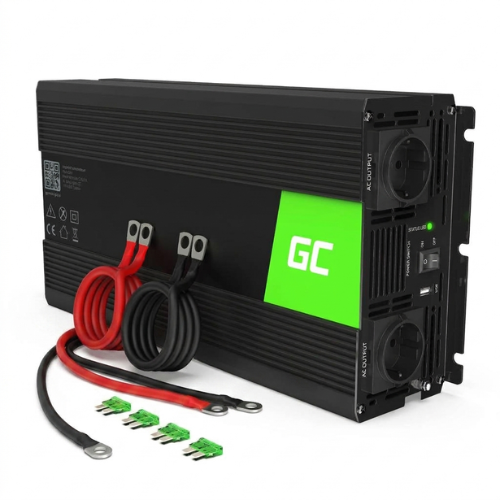
Green Cell 1500W / 3000W 12V to 230V Volt Inverter
1500W Continuous / 3000W Peak | 12V to 230V | Modified Sine Wave | Cigarette Lighter + Power Plug | Car, Solar, Caravan
Check Price on Amazon ↓
Check Price & Buy on Amazon →Which Inverter Should You Choose?
The answer depends entirely on your current caravan setup and what appliances you plan to run. Here's the definitive guide:
| Scenario | Recommendation |
| No battery bank yet / new build | Genus MaxiLion (all-in-one) |
| Already have 12V battery bank | Green Cell 1500W (add-on inverter) |
| Need to run AC / 1HP motor | Genus MaxiLion (pure sine wave) |
| Basic loads only (lights, fans, charging) | Green Cell 1500W (budget-friendly) |
| Want portable / removable option | Green Cell 1500W (take anywhere) |
| Want zero-maintenance solution | Genus MaxiLion (sealed lithium) |
| DIY solar setup needs AC output | Green Cell 1500W (solar compatible) |
| Maximum power + reliability | Genus MaxiLion 2.4KVA |
🎯 Our Recommendation:
Choose Genus MaxiLion if: You don't have a separate battery yet, want an all-in-one solution that eliminates wiring complexity, need to run heavy loads (AC, washing machine, motor), and value 12-year maintenance-free operation. It's the premium choice that simplifies everything.
Choose Green Cell 1500W if: You already have a 12V battery bank (LITOR, AGM, etc.), want a portable/removable inverter you can use anywhere, are on a tighter budget, or run primarily basic loads that don't require pure sine wave. It's the practical, versatile choice.
Both together? Absolutely works. Use the Genus as your primary heavy-duty system and keep the Green Cell as a backup/portable unit for camping trips away from the caravan or emergency home use during power cuts.
Advertisement
Frequently Asked Questions
Can I run an AC (air conditioner) from a caravan inverter?
Yes, but only with a sufficiently rated inverter. A 1HP AC needs approximately 2400-3000W during compressor startup (surge). The Genus MaxiLion 2.4KVA handles this. The Green Cell 1500W cannot handle AC startup surges — it's designed for lighter loads. For AC units, you need minimum 2.4KVA pure sine wave inverter.
What's the difference between the Genus (all-in-one) and buying a separate inverter + battery?
The Genus integrates inverter + 2560Wh lithium battery + BMS + charger in one box. A separate setup requires you to buy an inverter, buy a compatible battery, buy a BMS, wire them with heavy-gauge cables, configure charging parameters, and troubleshoot compatibility. The Genus eliminates all of that complexity — at the cost of less modularity (you can't upgrade just the battery independently).
Is modified sine wave safe for my laptop and phone?
Yes. Modern laptop chargers and phone chargers have internal voltage regulators (switch-mode power supplies) that handle modified sine wave perfectly. You might hear very faint coil whine from some laptop chargers, but there's zero damage risk. Millions of people charge laptops from modified sine wave inverters daily without issues.
How long will the Genus 2560Wh battery last on a single charge?
Depends on your load. Lights + fans + charging (150W): ~17 hours. Add a DC fridge (60W): ~12 hours. Add TV (80W): ~8-9 hours. Running an AC (1000W): ~2-2.5 hours. For typical caravan evening use (no AC), one charge easily lasts through the night and into the next afternoon until solar recharges it.
Can I charge the Genus MaxiLion from solar panels?
Yes. The Genus has a built-in intelligent charger that accepts input from solar charge controllers (via the AC input or dedicated solar input, depending on the model variant). Connect your solar panels → charge controller → Genus input, and it maintains the lithium battery automatically with proper charging profiles.
Can the Green Cell inverter be permanently installed in a caravan?
While it's designed as a portable unit, many caravan builders permanently mount it near the battery bank with proper ventilation. Use the heavy-gauge cable connectors (not cigarette lighter) for permanent installation. Ensure adequate airflow around the unit for cooling fan operation. It works fine as a permanent installation — you just lose the portability advantage.
⚡ Build your complete caravan power system — battery, solar, inverter, everything
Complete Caravan Battery & Power Guide →Related Articles
- Best Lithium Battery & Charger for Caravan
- Best Solar Panel Kits — 1600W & 2400W
- Best DC Fridge for Caravan & Camper
- Best Water Pumps for Caravan & RV
- Complete Caravan Build — ₹13 Lakh Breakdown
Written by Rajiv Sah
Founder, OnRoadCost & Josh Riders | info@onroadcost.com